
Latissimus Dorsi
Latissimus Dorsi
Stretches
Stretches
Latissimus Dorsi SHOULDER and BACK Stretch for All kneeling – Child’s Pose
Latissimus Dorsi SHOULDER and BACK Stretch for All kneeling – Child’s Pose
How to perform the stretch:
1. Start in a kneeling position with knees wide apart and hands on the floor under your shoulders keeping your elbows extended
2. This movement stretches both sides at the same time
3. Reach your hands forward and place them on the floor approximately 50cm in front of your shoulders
4. Flex the hips to bring your torso between your knees
5. Abduct (reach up) and Protract (push forward) your shoulders fully and sit back further into the pose to increase the stretch
6. Hold the stretch for 20 Seconds
7. Release the stretch
Latissimus Dorsi SHOULDER and BACK Stretch for All kneeling
Stretch NameLatissimus Dorsi SHOULDER and BACK Stretch for All kneeling
How to perform the stretch:
1. Start in a kneeling position
2. Choose the muscle or hip you intend to stretch
3. Abduct and Protract (reach up) your shoulders fully and grasp the wrist of the target shoulder with the opposite hand
4. Laterally flex the spine 20 degrees in the opposite direction of the target shoulder
5. Keeping the elbows extended, rotate the shoulders forward15 degrees to bring the hands ‘in front’ of the face
6. Laterally rotate (twist outward) the spine 15 degrees and ‘pull up’ the wrist with the opposite hand to increase the stretch
7. Hold the stretch for 20 Seconds
8. Release the stretch
Latissimus Dorsi SHOULDER and BACK Stretch for All standing
Latissimus Dorsi SHOULDER and BACK Stretch for All standing
How to perform the stretch:
1. Start in a standing position in front of a wall, approximately 1.5 metres away
2. This movement stretches both sides at the same time
3. Slightly flex the knees into a small squat
4. Extend the shoulders in front of the chest to 90 degrees and flex forward at the hips to place your hands on the wall
5. Extend, rotate upwards and protract (push out) your shoulders fully to bring your ears past your biceps
6. Flex further forward at the hips to increase the stretch
7. Hold the stretch for 20 Seconds
8. Release the stretch
Latissimus Dorsi SHOULDER Stretch for Intermediates kneeling – Downward Facing Dog Pose
Latissimus Dorsi SHOULDER Stretch for Intermediates kneeling – Downward Facing Dog Pose
How to perform the stretch:
1. Start in a kneeling position with hands on the floor under your shoulders keeping your elbows extended
2. This movement stretches both sides at the same time
3. Extend the hips and knees to ‘rise up’ into a plank position
4. Flex the hips to approximately 85 degrees to bring the face in line with the biceps
5. Extend, rotate upwards and protract (push out) your shoulders fully to increase the stretch
6. Hold the stretch for 20 Seconds
7. Release the stretch
Latissimus Dorsi SHOULDER Stretch for Advanced kneeling – Downward Facing Dog Pose
Latissimus Dorsi SHOULDER Stretch for Advanced kneeling – Downward Facing Dog Pose
How to perform the stretch:
1. Start in a kneeling position with hands on the floor under your shoulders keeping your elbows extended
2. This movement stretches both sides at the same time
3. Extend the hips and knees to ‘rise up’ into a plank position
4. Flex the hips to approximately 95 degrees to bring the ears past the biceps
5. Extend, rotate upwards and protract (push out) your shoulders fully to increase the stretch
6. Hold the stretch for 20 Seconds
7. Release the stretch
Latissimus Dorsi SHOULDER Stretch for Beginners standing walking lunge
Latissimus Dorsi SHOULDER Stretch for Beginners standing walking lunge
How to perform the stretch:
1. Start in a standing position with an anchor point in front of you
2. Choose the muscle or shoulder you intend to stretch
3. Grasp hold of the anchor point with the hand of this target shoulder, with the opposite hand on the hip
4. Step the leg of the target muscle rearward, to bring the feet 1 metre apart and in line with each other
5. Rotate the spine and torso towards 90 degrees to bring the ear under the biceps
6. Flex the hips and engage the leg muscles ‘pulling back’ to increase the stretch
7. Hold the stretch for 20 Seconds
8. Release the stretch
Latissimus Dorsi SHOULDER Stretch for Intermediates standing walking lunge
Latissimus Dorsi SHOULDER Stretch for Intermediates standing walking lunge
How to perform the stretch:
1. Start in a standing position with an anchor point in front of you
2. Choose the muscle or shoulder you intend to stretch
3. Grasp hold of the anchor point with the hand of this target shoulder, with the opposite hand on the hip
4. Step the leg of the target muscle rearward, to bring the feet 1.2 metres apart and in line with each other
5. Rotate the spine and torso towards 90 degrees to bring the ear under the biceps
6. Flex the hips and engage the leg muscles ‘pulling back’ to increase the stretch
7. Hold the stretch for 20 Seconds
8. Release the stretch
Latissimus Dorsi SHOULDER Stretch for Advanced standing walking lunge
Latissimus Dorsi SHOULDER Stretch for Advanced standing walking lunge
How to perform the stretch:
1. Start in a standing position with an anchor point in front of you
2. Choose the muscle or shoulder you intend to stretch
3. Grasp hold of the anchor point with the hand of this target shoulder, with the opposite hand on the hip
4. Step the leg of the target muscle rearward, to bring the feet 1.4 metres apart and in line with each other
5. Rotate the spine and torso towards 90 degrees to bring the ear under the biceps
6. Flex the hips and engage the leg muscles ‘pulling back’ to increase the stretch
7. Hold the stretch for 20 Seconds
8. Release the stretch
Muscle Details
Muscle Details
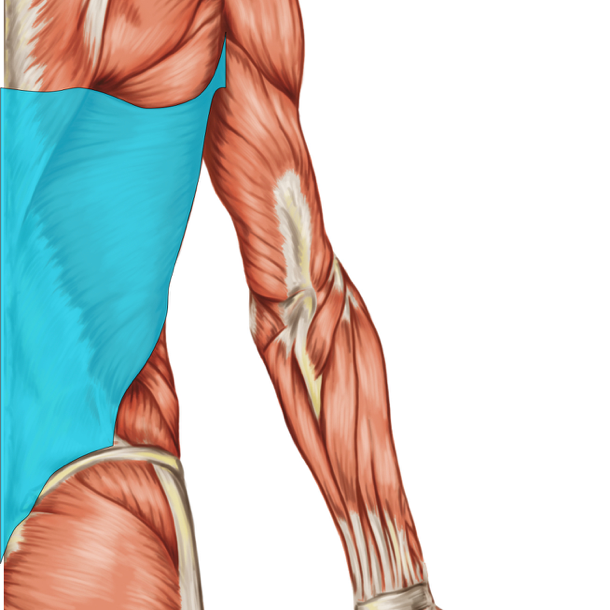
The Latissimus Dorsi muscle is the main extensor muscle of the arm. It is heavily involved in exercises such as swimming freestyle (front crawl) and performing chin-ups. It is also referred to sometimes as the ‘hand-cuff’ muscle as this is the main action that the muscle performs in bringing the arms and hands behind the back.
Origin:
- Spinous processes T7 – L5, the iliac crest, thoracolumbar fascia, posterior sacrum and ribs 9 – 12 (occasionally, the inferior angle of the scapula).
Insertion:
- Bicipital groove of the humerus on the medial lip.
Action:
- Adduction, extension and medial rotation of the shoulder. Anterior pelvic tilt and elevation of the pelvis. Depression and downward rotation of the scapula (only when it has an origin at the inferior angle of scapula).
Latissimus Dorsi over use injuries and muscle strain can occur with sports such as swimming and body building. Shoulder imbalance injuries can occur with throwing sports also.