
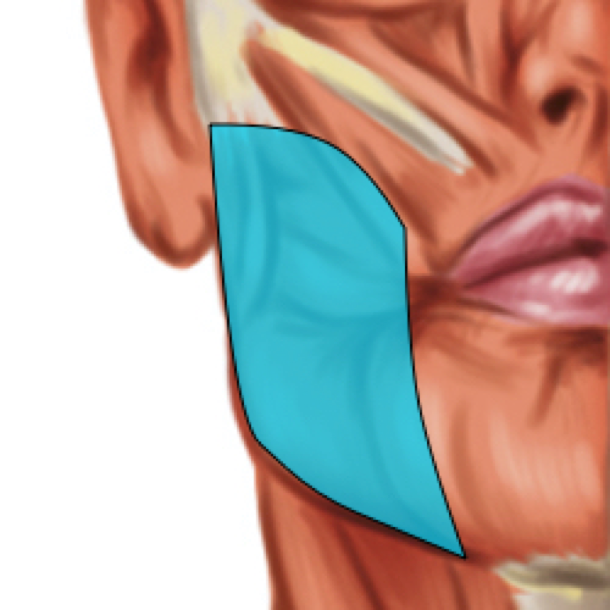
Masseter
Masseter
Stretches
Stretches
Masseter JAW Stretch for All sitting
Stretch NameMasseter JAW Stretch for All sitting
How to perform the stretch:
1. Start in a sitting position
2. This movement stretches both sides at the same time
3. Keep your face and neck in a neutral position
4. Open your mouth as wide as you comfortably can
5. Hold the stretch for 20 Seconds
6. Release the stretch
Masseter JAW Stretch for All sitting straight finger lock
Masseter JAW Stretch for All sitting straight finger lock
How to perform the stretch:
1. Start in a sitting position
2. This movement stretches both sides at the same time
3. Keep your face and neck in a neutral position
4. Bring your hands up towards your face and keep your fingers straight
5. Bilaterally lock your fingers into the muscle bodies upon each cheek, just in front of each ear lobe
6. Slowly open your mouth as wide as you comfortably can to increase the stretch
7. Hold the stretch for 20 Seconds
8. Release the stretch
Masseter JAW Stretch for All sitting curled finger lock
Masseter JAW Stretch for All sitting curled finger lock
How to perform the stretch:
1. Start in a sitting position
2. This movement stretches both sides at the same time
3. Keep your face and neck in a neutral position
4. Bring your hands up towards your face and curl your fingers into a half-moon shape
5. Bilaterally lock your fingers into the muscle bodies upon each cheek, just in front of each ear lobe
6. Slowly open your mouth as wide as you comfortably can to increase the stretch
7. Hold the stretch for 20 Seconds
8. Release the stretch
Muscle Details
Muscle Details
The primary action of the Masseter is elevation of the mandible (closing of the mouth) and is therefore one of the main muscles active during ‘chewing’ of food. Because of the leverage it develops on the mandible, it is considered as one of the strongest muscles in the body.
Origin:
- Superficial fibres – Zygomatic process (maxilla), the inferior border of zygomatic arch.
Deep fibres – Posterior aspect of the inferior border of the zygomatic arch.
Insertion:
- Superficial fibres – Angle and ramus of the mandible. Deep fibres – Superior ramus and coronoid process of the mandible.
Action:
- Elevation of the mandible (closing the mouth or clenching the teeth). Anterior fibres – Protraction of the mandible. Posterior fibres – Retraction of the mandible.
When people come under stressful situations, they can often ‘clench’ their jaw or ‘grind’ their teeth, therefore, constantly contracting the masseter muscle. This can lead to tension headaches or possibly even myospasm or ‘lock-jaw’.