
Teres Major
Teres Major
Stretches
Stretches
Teres Major, SHOULDER overhead Stretch for All standing
Teres Major, SHOULDER overhead Stretch for All standing
How to perform the stretch:
1. Start in a standing position next to an anchor point (such as a door frame)
2. Choose the target muscle or side of the body you intend to stretch by having this side next to the anchor
3. Extend and twist out (laterally rotate) the target shoulder vertically above the head
4. Side-bend the torso towards the anchor point
5. Grasp the anchor point with this target hand overhead
6. Slightly squat down and lean out the body away from the anchor point to increase the stretch
7. Hold the stretch for 20 Seconds
8. Release the stretch
Teres Major, SHOULDER crossbody Stretch for All standing
Teres Major, SHOULDER crossbody Stretch for All standing
How to perform the stretch:
1. Start in a standing position next to an anchor point (such as a door frame)
2. Choose the target muscle or side of the body you intend to stretch by having this side next to the anchor
3. Flex (Adduct) the target shoulder across the chest and twist out (laterally rotate) this shoulder
4. Side-bend the torso towards the anchor point
5. Grasp the anchor point with this target hand across the body
6. Slightly squat down and lean out the body away from the anchor point to increase the stretch
7. Hold the stretch for 20 Seconds
8. Release the stretch
Muscle Details
Muscle Details
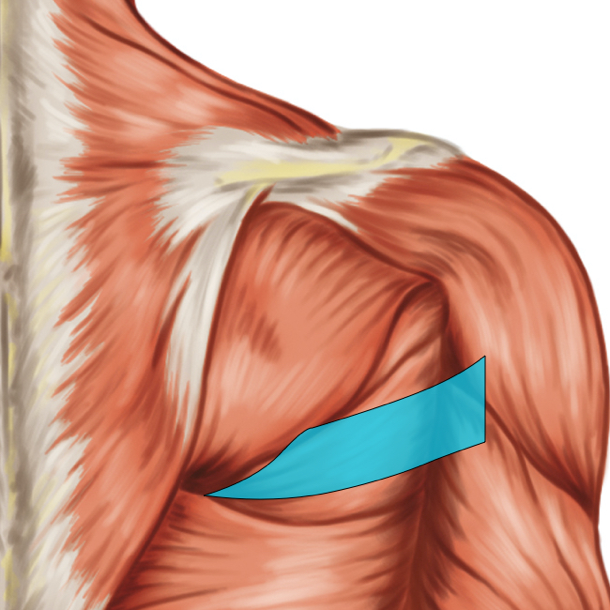
The Teres Major is also known as ‘the little latissimus’ as its fibre direction & action are very similar to that of the Latissimus Dorsi.
Origin:
- Inferior and lateral border of the scapula.
Insertion:
- Bicipital groove of the humerus upon the medial lip.
Action:
- Adduction and Medial rotation of the shoulder. Extension of the shoulder from the flexed position and assists in upward scapula rotation.
Teres Major muscle strain can occur during forceful or repetitive internal rotation of the shoulder, in sports such as golf. Can be injured during shoulder dislocation.